What It Is
A pinball machine is an electromechanical arcade game in which a player launches a steel ball onto a sloped playfield studded with bumpers, ramps, targets, and — since 1947 — player-controlled flippers. Points are scored by striking targets and completing sequences, with skilled players able to keep a single ball in play for extended periods. Modern machines layer in LCD screens, LED lighting, complex rule sets, and licensed themes from pop culture franchises.
The game's deceptive simplicity masks real depth: competitive pinball demands spatial awareness, reaction time, strategic shot selection, and the subtle art of "nudging" the cabinet without triggering the tilt sensor.[3]
Why It Matters
Pinball is far more than a game — it is a lens through which to view nearly a century of American social history. Its story intersects with the Great Depression, organized crime, wartime patriotism, youth counter-culture, the rise and dominance of video games, and a 21st-century hunger for tactile, analog experiences in an increasingly digital world.[3]
"Over the course of its history, pinball — including its gameplay, artwork, title themes, and game components — has reflected broader changes in social and cultural values, art, popular culture, game design, technology, and politics." — The Strong National Museum of Play[3]
The machine's journey from banned "gambling device" to celebrated cultural artifact mirrors shifting American attitudes toward leisure, morality, and the boundary between skill and chance. Today, pinball serves as a touchstone for discussions about preservation, craftsmanship, and the value of physical play in the digital age.
Origins & Early History
From Bagatelle to the Billion-Dollar Ball
Pinball's ancestor is bagatelle, a tabletop game that evolved from European lawn games where balls were rolled into holes in the ground. French soldiers brought bagatelle to America during the Revolutionary War, and it became a popular parlor pastime throughout the 19th century.[4]
In 1870, British immigrant Montague Redgrave patented a modernized version with a spring-loaded plunger and scoring bells — the fundamental mechanism that would define coin-operated pinball for the next century.[4]
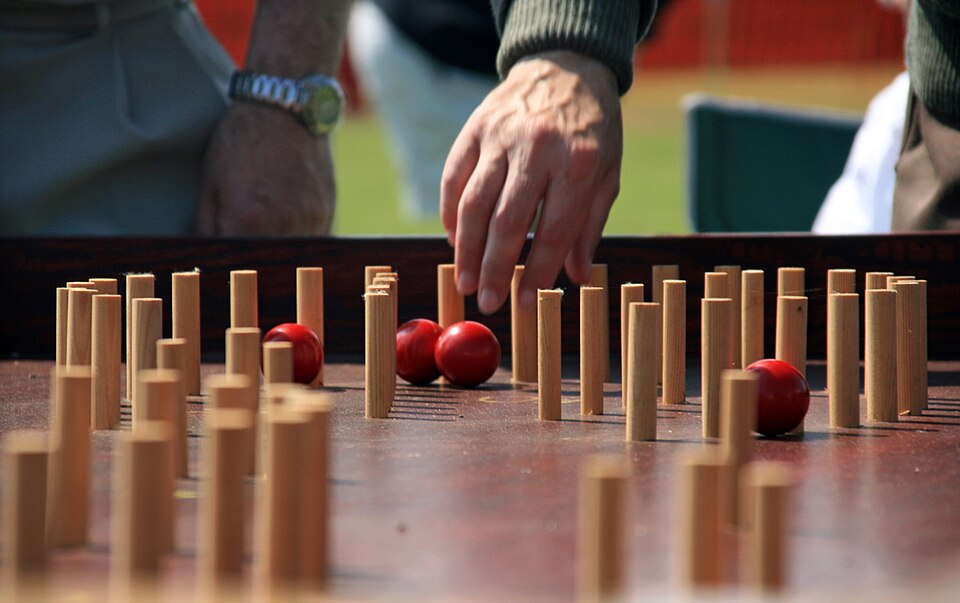
A 19th-century bagatelle table — pinball's direct ancestor. Source: Wikimedia Commons
The 1930s Boom
The Great Depression, counterintuitively, fueled pinball's rise. A penny per play offered cheap entertainment when people desperately needed it. In 1931, David Gottlieb released Baffle Ball, the first mass-produced pinball game, selling an astonishing 50,000 units and establishing Chicago as the industry's manufacturing center.[4]
That same year, Arthur Paulin and Earl Froom created Whiffle, an early glass-covered design. By 1933, Harry Williams pioneered electromechanical pinball with Contact, using dry-cell batteries to power ball kickers and electronic scoring.[4]
Key stat: The term "pinball" wasn't coined until 1936 — five years after the first coin-operated machines appeared. The name refers to the pins (small metal posts) that the ball bounced off on early playfields.[2]
The Flipper Revolution
Early pinball was entirely a game of chance — players launched a ball and watched gravity do the rest. That changed in 1947 when Gottlieb's "Humpty Dumpty" introduced six electromechanical flippers, allowing players to bat the ball back up the playfield. This single innovation transformed pinball from passive gambling device to active skill game — and would later become the legal argument that saved the industry.[2][4]
The Great Pinball Ban
One of the most remarkable chapters in American gaming history is the decades-long criminalization of pinball in major U.S. cities.
LaGuardia's Crusade
On January 21, 1942, New York City Mayor Fiorello LaGuardia banned pinball machines, launching Prohibition-style raids across the city. Police confiscated approximately 2,000 machines — estimated at one-fifth of the city's total. LaGuardia and Police Commissioner William P. O'Brien personally smashed machines with sledgehammers before cameras, then dumped the wreckage into Long Island Sound and the city's rivers.[1]
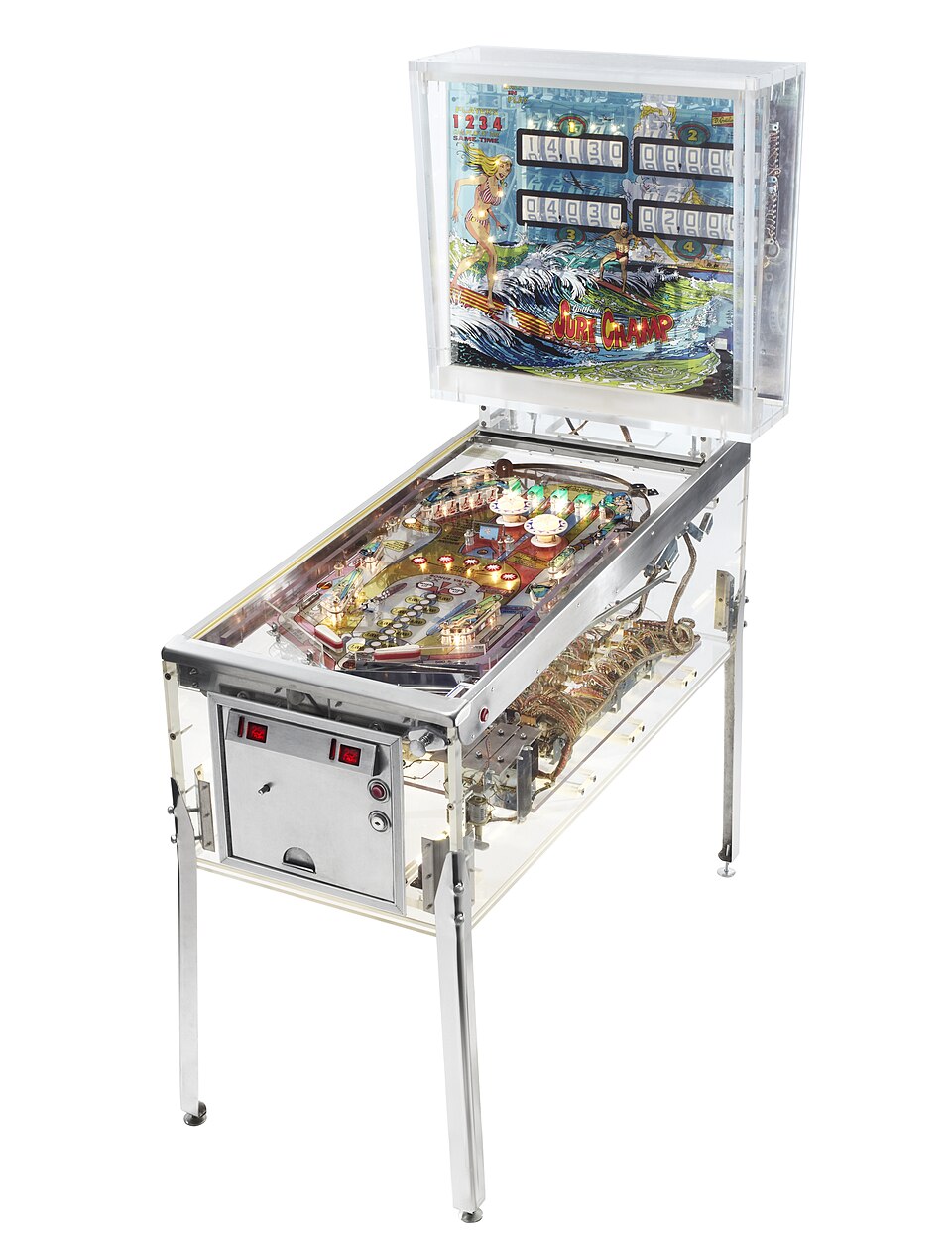
A vintage pinball machine with visible inner mechanisms, showing the electromechanical era. Source: Wikimedia Commons / Pacific Pinball Museum
Wartime propaganda: LaGuardia argued the machines' metal should be "manufactured into arms and bullets which can destroy our foreign enemies." The confiscated machines reportedly contained enough copper, aluminum, and nickel to build four 2,000-pound aerial bombs.[1]
Why It Was Banned
The justifications were many and varied:
- Gambling: Pre-flipper machines were pure chance, and many paid out prizes — jewelry, chinaware, even cash. Authorities classified them as gambling devices.[1]
- Organized crime: The "Murder, Inc." gang and other crime families controlled pinball distribution networks and used machines to launder money.[1]
- Moral panic: Churches and school boards claimed pinball corrupted children, encouraging them to steal lunch money, skip school, and go hungry.[1]
The ban spread to Los Angeles, Chicago, and other major cities. Pinball went underground — machines hidden in back rooms, often in establishments that already operated outside the law.[7]
Roger Sharpe's Miracle Shot
The ban persisted for over 30 years — even after flippers made pinball a skill game. The turning point came in 1976 when Roger Sharpe, a 26-year-old magazine writer and elite pinball player, was invited to demonstrate the game's skill component before the New York City Council.[1][7]
In a moment of high drama, Sharpe called his shot — announcing exactly where he would send the ball — and executed it perfectly. The council voted to overturn the ban. In 1974, the California Supreme Court had already ruled pinball was a game of skill, and with New York's reversal, the dominos fell nationwide.[1]
The Golden Age & the Video Game Threat
Solid State Revolution
The late 1970s brought microprocessors into pinball. In 1975, Mirco Games released The Spirit of '76, the first microprocessor-powered machine.[4] These "solid state" machines replaced electromechanical relays with circuit boards, enabling complex rule sets, digital scoring, and immersive sound design.[2]
Milestones came in rapid succession: Gorgar (1979) became the first talking pinball machine with its seven-word vocabulary.[4] Black Knight (1980) introduced multi-level playfields. Firepower (1980) gave players "multiball" — three balls in play simultaneously.[4]
Peak production: The pinball industry peaked in 1979 with sales of 200,000 machines. Three years later, after Pac-Man, Space Invaders, and other video games captured the arcade, sales plummeted 85%.[2]
The 1990s Renaissance
Despite the video game onslaught, pinball found a second wind. Designer Pat Lawlor's The Addams Family (1992) became the best-selling pinball machine of all time with over 20,000 units sold.[4] Other classics followed: Twilight Zone (1993) featured magnetic "invisible" flippers, a ceramic power ball, and a gumball machine integrated into the playfield. Medieval Madness (1997) remains a collector favorite.[2]
Near-Death Experience
Williams, the dominant manufacturer, made a last-ditch effort with Pinball 2000 (1999), a hybrid platform combining pinball with video screen overlays. Revenge From Mars succeeded commercially, but Star Wars: Episode I became Williams' final pinball release before shutting down its pinball division entirely.[2] For years, Stern Pinball remained the sole major manufacturer.
Key Figures
- David Gottlieb — Father of commercial pinball; his 1931 Baffle Ball launched the industry and sold 50,000 units.[4]
- Harry Mabs — Invented the flipper mechanism for Gottlieb's Humpty Dumpty (1947), the single most important innovation in pinball history.[4]
- Harry Williams — Pioneered electromechanical pinball in 1933 and founded Williams Manufacturing, which would dominate for decades.[4]
- Fiorello LaGuardia — NYC mayor who banned pinball in 1942, triggering a nationwide prohibition lasting over three decades.[1]
- Roger Sharpe — The writer and player whose "called shot" before the NYC Council in 1976 overturned the ban and legalized pinball.[1]
- Steve Ritchie — Designed Firepower (1980), the first multiball machine, and numerous other classic titles.[4]
- Pat Lawlor — Created The Addams Family (1992) and other top sellers; widely considered pinball's greatest designer.[2]
- Gary Stern — CEO of Stern Pinball, who kept the industry alive as the sole major manufacturer through pinball's darkest years.[2]
Current State
Pinball is in the midst of a genuine renaissance. After nearly going extinct in the 2000s, the industry has rebuilt around nostalgia, craftsmanship, and the growing appetite for analog entertainment.
Market Size
The global pinball market was valued at approximately $1.36 billion in 2025 and is projected to reach $2.76 billion by 2035, growing at a CAGR of 6.7%.[6] The used pinball market alone accounts for an estimated $143 million annually, with roughly 26,000 machines changing hands each year — about 72 per day.[5]
Collector prices: The average transaction price for a used pinball machine is $5,389, with rare titles from the 1990s golden age commanding $15,000–$30,000 or more.[5]
Manufacturers
Stern Pinball remains the industry leader, releasing at least three major titles per year with licenses like Marvel, Star Wars, and Metallica. Jersey Jack Pinball, founded in Lakewood, NJ, has pushed boundaries with LED backglass technology, Bluetooth connectivity, and built-in cameras since its 2013 debut with The Wizard of Oz.[2] Smaller companies like Spooky Pinball, American Pinball (recently relaunched under new ownership), and international makers in Spain and Australia have diversified the market.[2]
The Competitive Scene
Competitive pinball has exploded. The International Flipper Pinball Association (IFPA) tracks over 137,000 registered players competing in thousands of tournaments worldwide — up from just 500 players in 50 events back in 2006.[8] Dedicated pinball bars, museums, and arcades have opened in cities across the U.S., including museums in Seattle, Las Vegas, New York City, and Asheville, North Carolina.
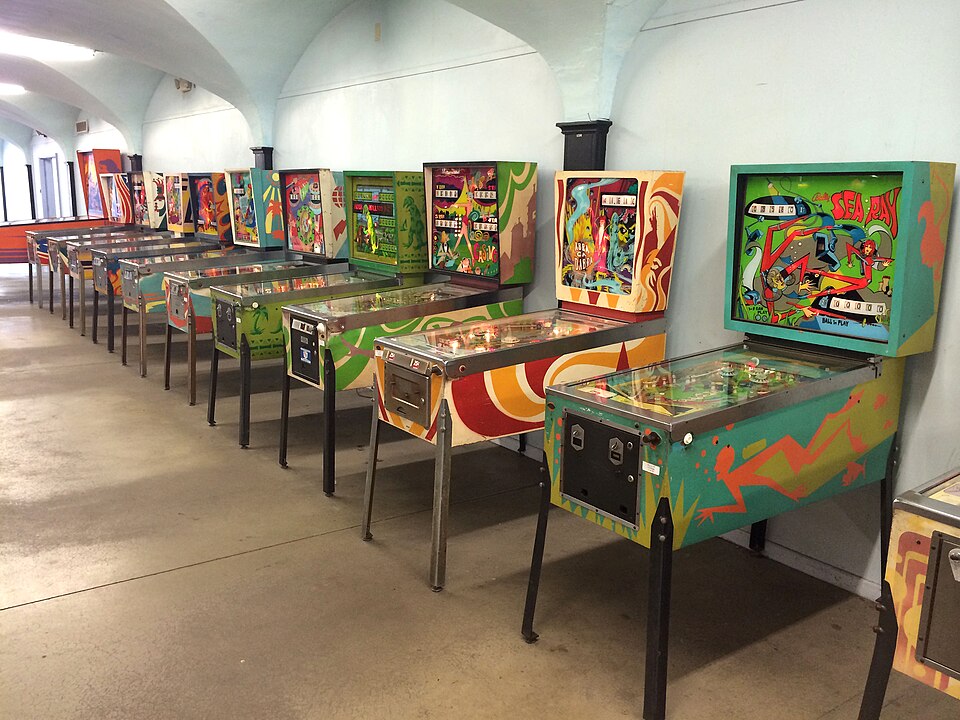
Modern pinball machines lined up in an arcade setting. Source: Wikimedia Commons
Open Questions
- Sustainability of the revival: Pinball's resurgence is real, but new machines cost $6,000–$12,000+. Can the industry sustain growth beyond affluent collectors and commercial venues, or will pricing limit the market?
- Digital vs. physical: Virtual pinball platforms like The Pinball Arcade and Zen Pinball introduce new players, but do they cannibalize physical machine sales or serve as a gateway?
- Licensing dependency: Modern pinball relies heavily on pop culture licenses (Marvel, Star Wars, Stranger Things). What happens when licensing costs rise or major IP holders pull back?
- Preservation: Tens of thousands of classic machines are deteriorating. Electromechanical parts are no longer manufactured, and specialized repair knowledge is aging out. Who will preserve this cultural heritage?
- Diversity and access: The competitive and collector communities remain overwhelmingly male and predominantly white. How can the community broaden its appeal and welcome new demographics?
Where It's Headed
Several trends point to pinball's continued evolution:
- Technology integration: Internet-connected machines now support global leaderboards, software updates, and remote diagnostics. Jersey Jack's "Dialed In" (2017) was the first machine with Bluetooth and smartphone controls.[2]
- Experience economy: The arcade gaming market is projected to grow by $2 billion from 2025 to 2029, driven partly by demand for tangible, social entertainment that screens can't replicate.[8]
- New manufacturers: The entry of companies like American Pinball (relaunched) and international makers is increasing competition and innovation, pushing design boundaries beyond what a single dominant manufacturer could achieve.
- Museum and cultural recognition: The Strong National Museum of Play in Rochester, NY houses the Williams Pinball Playfield Design Archive and a major pinball exhibit, cementing pinball's status as a legitimate cultural artifact worthy of preservation.[3][4]
- Nostalgia meets novelty: Millennials and Gen X nostalgia continues to drive demand, while Gen Z discovers pinball through bars, arcades, and streaming content. The tactile, unpredictable nature of the steel ball remains, as Stern's marketing director put it, "an entertainment device that can't be replicated."[6]
Sources
- Dave Roos, "That Time America Outlawed Pinball," HISTORY, Aug 2021. history.com
- "Brief History of Pinball," Joseph Henry Project, Princeton University. commons.princeton.edu
- "Pinball Matters," The Strong National Museum of Play. museumofplay.org
- "Pinball in America," Google Arts & Culture / The Strong. artsandculture.google.com
- "Sizing the Used Pinball Market," Kineticist, 2023. kineticist.com
- "Pinball Machines Market Size, Trends, Report Growth, 2035," Business Research Insights, 2025. businessresearchinsights.com
- "Pinball Was Banned in New York Until a Single Miraculous Shot," Slate / Atlas Obscura, May 2015. slate.com
- "Pinball Wizardry: The Resurgence of Pinball in Modern Arcades," Captain Crazy's Paradise, 2025; IFPA competitive data. captaincrazysparadise.com